






Parent Resources
Parent Resources

Ohio Teen Driver Checklist: How to Get Your License in 2025
Getting your license in Ohio can feel a little confusing, but don’t worry, we’ve broken it down into clear steps, so you know exactly what to do.
- Age: You must be at least 15 years and 6 months old.
- What to bring to the BMV:
- Proof of your name, date of birth, Social Security Number, legal presence, and Ohio residency.
- At the BMV:
- Pass a vision test.
- Take and pass the written knowledge test.
- Pay the permit fee.
- Valid for: 1 year. If it expires, you’ll need to retake the test and pay again.
If you’re under 18, you’ll need:
- 24 hours of classroom or online lessons (through a BMV-approved program).
- 8 hours of driving with a licensed instructor.
- 50 hours of practice with a parent/guardian (10 of those hours at night).
- It must be done within 6 months.
Once finished, you’ll get a Driver Education Certificate, which you’ll need to book your
driving test.
- Requirements:
- Be at least 16 years old.
- Have your permit for at least 6 months.
- Complete all the education and practice hours.
- Testing:
- Pass the driving test and maneuverability test.
- Bring your Driver Education Certificate and notarized 50-Hour AƯidavit.
- Pay the license fees.
- After passing: Visit a license agency within 60 days to get your probationary license.
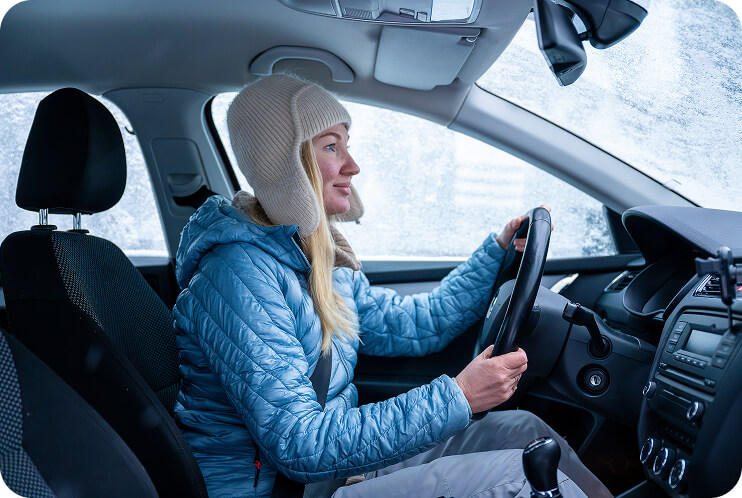
Winter Driving: Stay Safe & Avoid Risks
Winter roads can be super tricky, so it’s important to think smart before you drive.
- Ask yourself: Do I really need to go right now? Waiting a couple of hours gives plows
time to clear roads and temps a chance to warm up. - If you do go:
- Slow down.
- Leaving extra space between cars—stopping takes way longer on snow and ice.
- Even with 4WD or new tires, snow can mess with your traction.
- Watch your view: Big piles of snow can block intersections. Stop fully, then inch
forward until you can see clearly. - Look both ways: Cars on cross streets might slide into the intersection if they can’t
stop. - At turns: Other cars may slide into your lane—try not to enter the intersection at the
same time as them.
- Small bag of sand, salt, or kitty litter (for traction)
- Small shovel, snow brush, and ice scraper
- Flashlight
- Blankets
- Jumper cables and flares/triangles
Store this stuff in your trunk so it doesn’t fly around or block your pedals.
Drive safely out there!

Eliminate Distractions
Here’s a scary fact: 59% of teen passenger deaths happen in cars driven by another teen. Almost half of all teen crashes involve one or more teen passengers. The more teens in the car, the higher the risk of a serious crash.
- Friends can be a big distraction—talking, joking, or even pressuring the driver.
- Drivers with teen passengers are more likely to speed or take risks compared to
when they’re driving with adults. - Peer pressure makes it tough: everyone else can goof oƯ, but the driver must stay
focused. - Sometimes passengers even mess with the driver—like grabbing the wheel or
nudging them—which is extremely dangerous.
Ohio
- Drivers under 17: Can’t have more than 1 passenger who isn’t family,
unless a parent/guardian is in the car.
- Learn the rules together so everyone knows what’s allowed.
- Make it clear in a Parent–Teen Driving Agreement what happens if the law is
broken. - Remind your teens: passengers should help, not distract. A good friend is a safe “copilot” who speaks up if the driver loses focus.
Driving with friends can be fun, but safety comes first. Fewer passengers = Fewer risks. Always stay focused, follow the law, and drive safely!
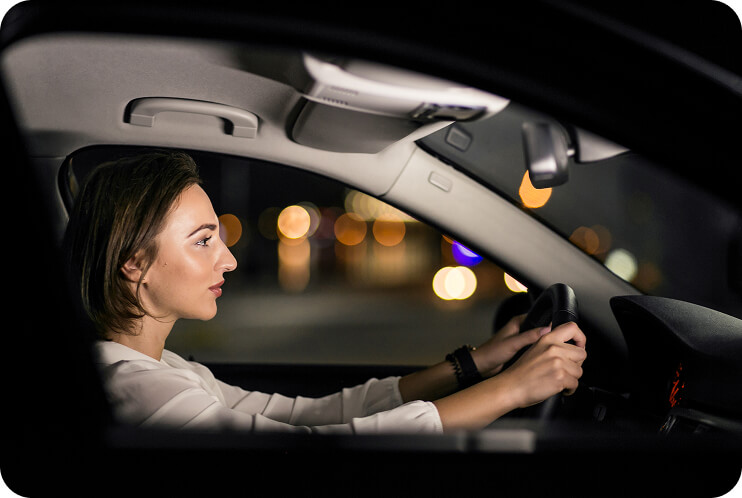
Driving at Night: Stay Safe
When the days get shorter, you’ll end up driving more in the dark. But here’s the deal: driving at night is about 3 times riskier than driving in daylight. Why? Because you can’t see as well—your depth perception, side vision, and ability to judge speed are all weaker at night.
- Slow down & leave space. It takes longer to react when you can’t see as far ahead.
- Use your headlights. Turn on your low beams at dusk so others see you. Use high beams on dark roads but switch them oƯ for oncoming cars or if you’re behind someone.
- Don’t stare at bright lights. If another car’s high beams are blinding you, look toward the right edge of the road to stay on track.
- Keep windows clean. A dirty windshield makes glare way worse at night.
- Dim your dash lights. Bright dashboards = more glare in your eyes.
- Don’t smoke in the car. Smoking makes it harder to see clearly at night.
- Stay alert. There are more drunk, high, or tired drivers on the road at night. Always be scanning for anything unusual.
Night driving is tougher, but slowing down, staying focused, and using your lights right makes a big diƯerence.

Driving in Rain & Fog
Bad weather makes driving harder—especially for new drivers. Wet roads and fog mean less traction and less visibility, which is why so many crashes happen in these conditions.
- Fact: Driving too fast for the weather is the #2 cause of fatal crashes.
- Fact: Hydroplaning (when your tires lose contact with the road because of water) can happen at just 30 mph.
The good news? Practicing in the rain and fog (when it’s safe) can make you a much better, more confident driver.
- Slow down. Speed limits are for perfect weather, not rain and fog.
- Leave more space. Instead of the normal 3-second gap, give 5 seconds or more.
- Brake gently. Start slowing down earlier and press the brakes smoothly to avoid skids.
- Avoid puddles. If you can safely change lanes to skip standing water, do it.
- Use low beams. High beams bounce oƯ fog and rain, making it harder to see.
Pro Tip: Practice driving in bad weather with a parent or instructor—only when it’s safe. The more you learn in real conditions, the better prepared you’ll be.
Drive safe!

Don’t Drive Distracted
When you’re behind the wheel, every second counts. A quick text, glance, or distraction can be the diƯerence between making it home safe—or not.
- 16% of fatal crashes happen because the driver was distracted.
- Teens are the #1 age group for distraction-related crashes.
- Texting while driving makes you 23 times more likely to crash.
- Talking on the phone cuts your brain’s focus on driving by 37%.
- Still, 1 out of 5 drivers (and over 1 out of 3 drivers age 18–27) admit to texting while driving.
It’s not just texting either—eating, messing with music, or even silly stuƯ like shaving or
reading behind the wheel can cause serious crashes.
- Lead by example. Teens copy what they see—if parents’ text and drive, chances are their kids will too.
- Put phones away. The safest phone is one that’s oƯ while driving.
- Set rules. Talk with your teens before they start driving. Make it clear: no texting, no calls, no distractions. A “No Tolerance” policy and a Parent–Teen Driving Agreement can help set clear boundaries.

Be a Good Role Model
Teens don’t just listen to what parents say, they copy what parents do. That means the way you drive directly influences how your teens drive.
- Do I ever drive angry, upset, or stressed? Or do I calm down before getting behind the wheel?
- Do I drive when I’m super tired?
- Do I ever drink and drive, or ride with someone who does?
- Do I always wear my seatbelt—and make sure everyone else in the car does too?
- Stay calm, focused, and confident.
- Respect other drivers—even if they mess up.
- Drive the speed limit and adjust for road/weather conditions.
- Don’t tailgate—always keep a safe 3–5 second gap.
- Avoid distractions (no texting, eating, or messing with your phone).
- Don’t drive aggressively—no cutting people oƯ or racing through traƯic.
Remember: Your teens are watching every move you make. If you drive safe, respectful, and focused, they’ll be much more likely to do the same.
Be the example you want your teens to follow.
Drive safely!
Learning to drive is a huge milestone — and as a parent, you play the biggest role in your teen’s success. Youth Driving Schools gives parents the resources, tools, and expert tips to support a new driver every step of the way, from the permit test to the BMV road test.
Parent Resources to Support Your Teen Driver
From study tools to coaching tips, we make sure you have what you need. Helpful guides for parents include:
- Ohio 50-Hour Driving Log: Parent Guide — how to make every supervised practice hour count
- Defensive Driving for Teens — the skills that prevent the majority of teen crashes
- Avoiding Distracted Driving — how to keep your teen focused behind the wheel
Your Role as a Parent
Teens whose parents stay involved — modeling safe driving, enforcing Ohio’s graduated licensing rules, and coaching during practice — become noticeably safer drivers. Use the parent resources above to guide your teen, and when they are ready, our Teen Program provides professional behind-the-wheel training with licensed instructors.
Driver Fatigue Quiz
Being tired while driving is a big deal can be just as dangerous as driving drunk. Think you know the facts? Test yourself with this quick quiz:


